How AI Actually Works (No Math Required)
Artificial intelligence can feel almost suspiciously intelligent. You ask a chatbot a question and it writes an answer. Your phone recognizes a face in a photo. Spotify seems to know what song you might want next. A navigation app predicts traffic before you get there. An AI image generator creates a picture of something that has never existed.
By Mekhi Hensley on September 11, 2026
Getty Images
Artificial intelligence can feel almost suspiciously intelligent.
You ask a chatbot a question and it writes an answer. Your phone recognizes a face in a photo. Spotify seems to know what song you might want next. A navigation app predicts traffic before you get there. An AI image generator creates a picture of something that has never existed.
It is tempting to imagine that somewhere inside these systems is a digital brain that “understands” the world in roughly the same way we do.
That’s not quite what is happening.
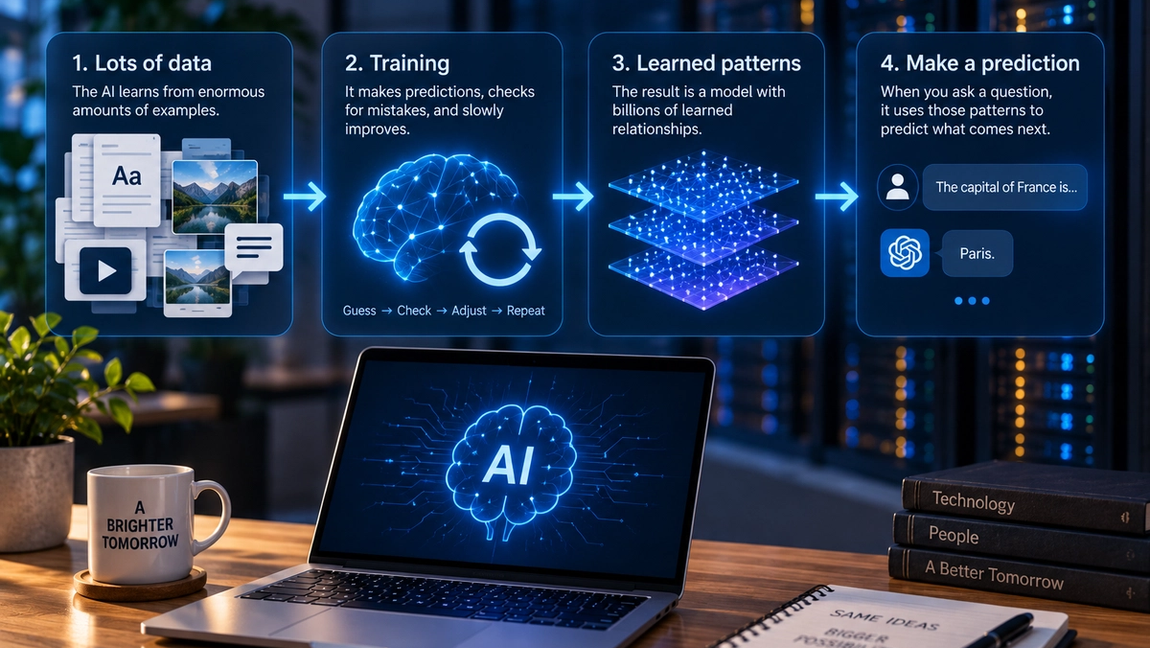
Modern AI is built on plenty of complicated mathematics, but you don’t need any of it to understand the basic idea. At its core, AI learns patterns from enormous amounts of data and uses those patterns to make predictions.
Everything else gets much more interesting from there.
AI learns from examples
Traditional computer programs usually work through explicit instructions.
A programmer might write rules saying: if this happens, do that. If the user clicks this button, open this page. If the password is incorrect, display an error.
AI works differently.
Instead of giving the computer a rule for every possible situation, developers can give it large numbers of examples and allow it to learn patterns from them.
Imagine you wanted a computer to recognize cats.
Writing down every rule that defines a cat would be surprisingly difficult. Cats can be black, white, orange, tiny, enormous, fluffy, hairless, sitting, jumping, or partially hidden behind a sofa.
Instead, you could show an AI system huge numbers of images, some containing cats and others not. During training, the system gradually learns which visual patterns tend to be associated with cats.
Eventually, when shown an image it has never seen before, it can predict whether that image probably contains a cat.
It hasn’t memorized one universal definition of “cat.” It has learned patterns that help it make a good prediction.
Training is where most of the learning happens
Before an AI system can do anything useful, it usually goes through a process called training.
During training, the system is repeatedly given examples and asked to make predictions. At first, those predictions may be terrible.
It makes a guess. The system measures how wrong that guess was. Its internal settings are adjusted slightly. Then it tries again.
This happens over and over—potentially billions or trillions of times.
Think of someone learning to shoot a basketball. Their first shot might go too far left. They adjust. The next goes too far right. They adjust again.
After enough practice, they don’t consciously calculate every movement. They have gradually developed a feel for which movements are likely to produce the desired result.
AI training is obviously very different from human practice, but the basic analogy is useful: repeated attempts and corrections gradually improve performance.
The result is a model containing an enormous collection of learned numerical relationships.
A chatbot is basically predicting what comes next
Large language models, the technology behind many modern AI chatbots, are trained using enormous amounts of text.
During training, the model learns relationships between words, phrases, concepts, writing styles, facts, and patterns in language.
Then comes the surprisingly simple part.
When you ask a language model a question, it generates its response by repeatedly predicting what should come next.
Suppose you write:
“The capital of France is…”
The model has learned that “Paris” is extremely likely to follow.
But real conversations are much more complicated than completing one sentence. Modern language models consider the context of your prompt and the text they have already generated while deciding what should come next.
They don’t simply predict entire answers at once.
They generate pieces of language called tokens, one after another, extremely quickly.
One token leads to another, then another, until an entire paragraph—or even an entire essay—appears.
Why AI can seem like it understands you
This is where things get strange.
If an AI system is “just predicting,” why can it explain philosophy, write computer code, summarize documents, create jokes, or help plan a vacation?
Because predicting language extremely well requires learning an extraordinary amount about the patterns behind language.
Words aren’t randomly arranged. They contain information about relationships, concepts, objects, events, arguments, emotions, and the world people describe.
By learning how language fits together, large AI models develop internal representations that allow them to perform surprisingly sophisticated tasks.
That doesn’t necessarily mean they understand things exactly as humans do.
A person experiences the world through senses, memories, emotions, relationships, and physical existence. An AI model processes information through mathematical representations.
The outputs can sometimes look remarkably human even though the process producing them is fundamentally different.
AI doesn’t simply search a giant database
Another common misconception is that a chatbot works like Google.
You ask a question, it searches through everything it has ever read, finds the answer, and copies it back to you.
That generally isn’t how a language model works.
During training, information influences the model’s internal parameters—the enormous collection of numerical settings that determine its behavior.
When you later ask a question, the model uses those learned patterns to generate an answer.
This distinction explains both AI’s impressive abilities and one of its biggest weaknesses.
Because it generates rather than simply retrieves information, AI can create completely new combinations of ideas. But it can also generate something that sounds perfectly reasonable and happens to be wrong.
These mistakes are often called hallucinations.
The AI isn’t necessarily “lying.” It is producing an answer that fits the patterns it has learned, even when those patterns lead to an incorrect result.
Why AI needs so much computing power
Training modern AI systems requires enormous amounts of computation.
The model may process huge datasets while adjusting billions of internal parameters again and again.
Specialized computer chips, particularly GPUs, are useful because they can perform many calculations simultaneously. Large AI training projects can involve thousands of powerful chips working together for extended periods.
Once a model has been trained, using it is generally much less computationally demanding than training it from scratch—but serving millions of users still requires substantial infrastructure.
So, just like the internet’s “cloud,” AI isn’t floating somewhere in cyberspace.
Behind the chatbot window are very real data centers filled with very real computers consuming electricity and processing calculations incredibly quickly.
AI is powerful precisely because it isn’t programmed for one answer
The most important thing to understand about modern AI is that nobody manually writes every response it can produce.
Developers build the architecture, choose training methods and data, establish objectives, evaluate results, add safeguards, and refine how the system behaves.
But when you ask an AI to explain black holes as if you’re ten years old, there probably isn’t a prewritten “black holes for ten-year-olds” answer waiting somewhere.
The model generates one for you.
That’s what makes modern AI fundamentally different from many older computer systems.
It isn’t simply following a giant list of prepared instructions. It has learned patterns flexible enough to handle situations its developers could never individually predict.
And that’s also why AI can occasionally surprise even the people who built it.
Underneath all the futuristic terminology, though, the central idea remains surprisingly simple:
Give a machine enormous numbers of examples. Let it learn the patterns connecting them. Then use those patterns to make predictions about something new.
Do that at a massive enough scale, and prediction can start looking remarkably like intelligence.