The Quiet Return of Real-Life Hobbies
You couldn’t just run; you needed a GPS watch, performance data, and perhaps a social account documenting the running. You couldn’t casually take photographs; you needed to build a portfolio. If you baked beautiful cakes, someone eventually suggested you should sell them. If you knitted, painted, gardened, or made pottery, the question wasn’t simply whether you enjoyed it. It was whether you could turn it into a side hustle.
By Gia Paul on September 11, 2026
Getty Images
For a while, hobbies seemed to become strangely complicated.
You couldn’t just run; you needed a GPS watch, performance data, and perhaps a social account documenting the running. You couldn’t casually take photographs; you needed to build a portfolio. If you baked beautiful cakes, someone eventually suggested you should sell them. If you knitted, painted, gardened, or made pottery, the question wasn’t simply whether you enjoyed it. It was whether you could turn it into a side hustle.
Meanwhile, much of our free time quietly migrated onto screens. We finished work on a laptop, relaxed by watching television, checked our phones during the television, and occasionally wondered why eight hours of sitting down had somehow left us exhausted.
Now something is shifting.
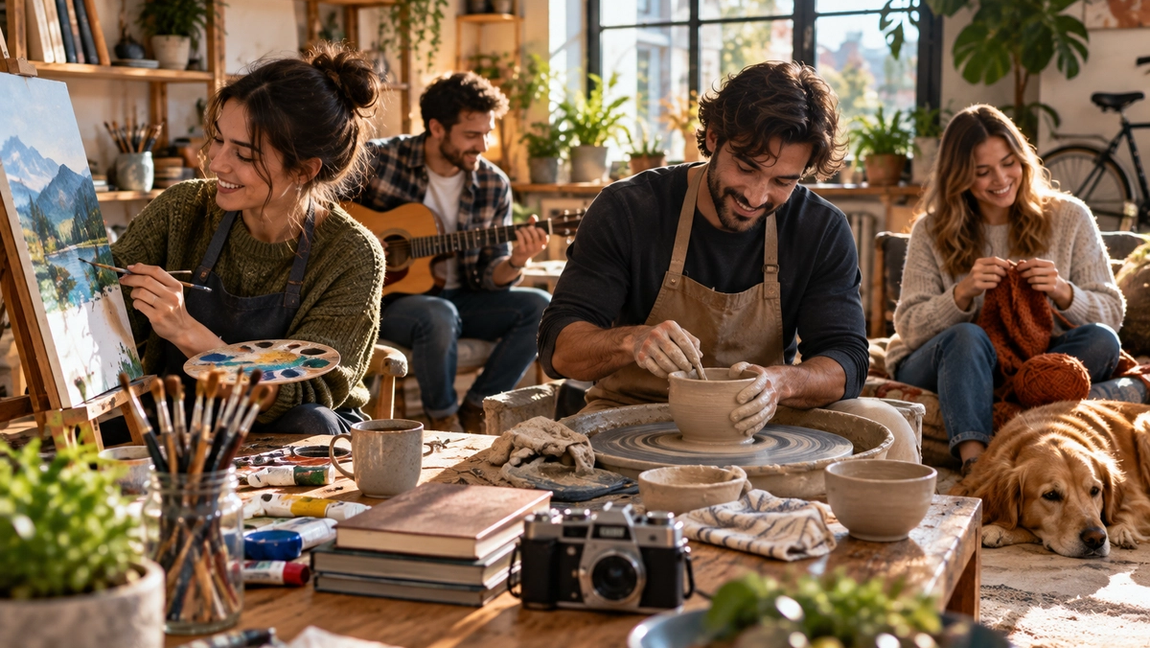
People are returning to hobbies that involve their hands, bodies, neighborhoods, and other human beings. Running clubs are becoming social scenes. Pottery studios are filling up. People are knitting, gardening, playing board games, taking dance classes, joining book clubs, baking bread, shooting film photography, and learning crafts that would have looked hopelessly inefficient a decade ago.
The hobby is making a comeback.
And perhaps the most interesting part is that many people don’t seem particularly interested in making it productive.
We got tired of spending all day on screens
Digital life solved countless problems, but it also created an unusual situation: work and leisure started happening in exactly the same place.
You finish a work document and open a browser. You close your email and open social media. You leave a video meeting and watch a video for entertainment.
Technically, the activity has changed.
Physically, almost nothing has.
A real-world hobby interrupts that pattern.
Gardening involves dirt, weather, plants, and movement. Pottery gives your hands something physical to manipulate. Playing football requires other people and an actual field. Cooking fills a room with smells and produces something you can touch and eat.
These experiences provide something screens struggle to replicate: a clear sense that you’ve changed environments.
Your attention isn’t simply moving from one rectangle to another.
Making things feels surprisingly satisfying
Modern life allows us to consume almost endlessly.
There is always another episode, article, video, podcast, post, game, or playlist available.
Making something reverses the direction.
Instead of receiving, you produce.
The result doesn’t have to be impressive. In fact, the slightly terrible first attempt may be part of the pleasure. You make a crooked bowl. You bake a loaf that looks nothing like the photograph. You paint something nobody would voluntarily hang in a museum.
And yet you made it.
Physical hobbies provide visible evidence of effort. At the end of two hours, something exists that didn’t exist before.
That can feel deeply satisfying in a world where much of our daily work is abstract, digital, and difficult to point at.
People are rediscovering the joy of being bad at something
Adults don’t get many opportunities to be beginners.
At work, we’re expected to know what we’re doing. In social situations, we try to appear competent. Online, we mostly see people’s finished results rather than their awkward early attempts.
A hobby gives you permission to be terrible.
Your first tennis serve can fly into another court. Your first pottery bowl can collapse. Your first guitar chord can sound like furniture falling down a staircase.
Nothing terrible happens.
You try again.
There is freedom in doing something where the stakes are low enough that failure can be funny.
Improvement also becomes unusually visible. Something that felt impossible three months ago becomes automatic. You don’t need a performance review to tell you you’ve improved.
Your hands know.
Not everything needs to become a side hustle
The internet has made monetization feel like the natural final stage of being good at something.
Friends taste your cookies and tell you to start a business. Someone sees your photographs and suggests selling prints. You make jewelry and immediately hear that you should open an online store.
The compliment is well intended.
But turning a hobby into income changes your relationship with it.
Now there are customers. Deadlines. Prices. Marketing. Inventory. Expectations.
The thing you once did to escape work can quietly become more work.
There is nothing wrong with building a business from something you love. Plenty of great companies begin exactly that way.
But profitability isn’t the highest possible achievement for every interest.
You’re allowed to become extremely good at something that earns you absolutely nothing.
Hobbies are becoming a way to meet people again
Adult friendship has a logistics problem.
When you’re young, friendship happens almost automatically because you repeatedly occupy the same places with the same people. School, university, sports teams, and shared housing create regular contact.
Adult life often removes that structure.
You can have hundreds of online connections and still struggle to find someone to have coffee with on Thursday.
Real-world hobbies recreate repeated contact.
Running clubs, climbing gyms, book groups, dance classes, amateur sports teams, craft workshops, choirs, and community gardens put people in the same physical place regularly.
That’s important because friendship usually isn’t created through one perfect conversation.
It grows through repetition.
You see someone again. Then again. Eventually, you’re no longer strangers.
The activity gives everyone a reason to keep showing up.
Old-fashioned hobbies suddenly feel fresh
Some of the activities attracting new interest are remarkably old.
Sewing. Knitting. Gardening. Baking. Woodworking. Ceramics. Fishing. Chess. Hiking.
None needed reinventing.
What changed was the environment around them.
When daily life becomes increasingly digital, activities involving physical materials feel different. When everything is designed for speed, hobbies that take months to learn can become appealing. When so much entertainment arrives automatically, doing something that requires effort feels strangely rewarding.
Yesterday’s ordinary activity can become today’s escape.
Even analog technologies have acquired new charm. Film cameras, records, notebooks, and printed books introduce friction that digital alternatives deliberately removed.
Apparently, sometimes we miss the friction.
A hobby gives the week landmarks
Without deliberate activities, weeks can blur together.
Work. Dinner. Phone. Television. Sleep. Repeat.
A hobby gives Tuesday a reason to be Tuesday.
Tuesday is climbing night. Thursday is pottery class. Saturday morning is the running group. Sunday afternoon is when you work in the garden.
These small appointments create rhythm.
They also give you something to anticipate that isn’t work or a major event.
Not every enjoyable thing needs to be a vacation, wedding, concert, or expensive dinner.
Sometimes having something small to look forward to every Wednesday improves life more than one spectacular weekend every six months.
The best hobbies make time disappear
There is a particular kind of satisfaction in looking at the clock and realizing two hours have passed without you noticing.
It happens when an activity demands enough attention to absorb you without feeling exhausting.
You might experience it while painting, running, cooking, fixing something, playing music, or building a ridiculously complicated miniature train landscape in your basement.
The specific hobby almost doesn’t matter.
What matters is that for a while, you’re completely occupied.
You aren’t checking whether anyone has messaged you. You aren’t following the news. You aren’t thinking about the meeting tomorrow.
You’re just doing the thing.
That kind of absorption has become increasingly rare.
You don’t need to be passionate about it
The search for a hobby can become another optimization project.
People ask, “What’s my passion?” as though somewhere in the world there is one perfect activity waiting to reveal their true identity.
There probably isn’t.
You can choose something simply because it seems mildly interesting.
Try pottery because you like mugs. Join a running group because your friend goes. Learn guitar because there’s one song you’d like to play. Plant tomatoes because tomatoes are good.
You don’t need to know whether you’ll still be doing it in ten years.
The whole point of hobbies is that the stakes can remain low.
Try things.
Quit some of them.
Keep the ones that make you want to return.
Leisure doesn’t have to accomplish anything
Perhaps the return of hobbies reflects something bigger than nostalgia for analog life.
We’re beginning to recognize how strange it is that even leisure became something we felt pressured to optimize.
Exercise should improve our bodies. Reading should make us smarter. Creative activities should become businesses. Travel should produce photographs. Free time should somehow contribute to becoming a better version of ourselves.
But leisure doesn’t always need a measurable outcome.
You can paint because painting is enjoyable.
You can garden because you like being outside.
You can play football badly with your friends because Saturday afternoon is more fun when you do.
The value is in the hours themselves.
In a culture obsessed with efficiency, that may be the quiet appeal of real-life hobbies.
They give us somewhere to spend our time without asking us to turn that time into anything else.