How Encryption Keeps Your Data Safe
Every day, you send information across networks you can’t see and through computers you don’t control. You enter your credit card number into an online store. You send private messages to friends. You log into your bank account. You upload photos to cloud storage. You connect to Wi-Fi at an airport or hotel.
By Michaela Hall on September 11, 2026
Getty Images
Every day, you send information across networks you can’t see and through computers you don’t control.
You enter your credit card number into an online store. You send private messages to friends. You log into your bank account. You upload photos to cloud storage. You connect to Wi-Fi at an airport or hotel.
Somehow, all of that information is supposed to reach the right destination without random strangers being able to read it along the way.
One of the main technologies making that possible is encryption.
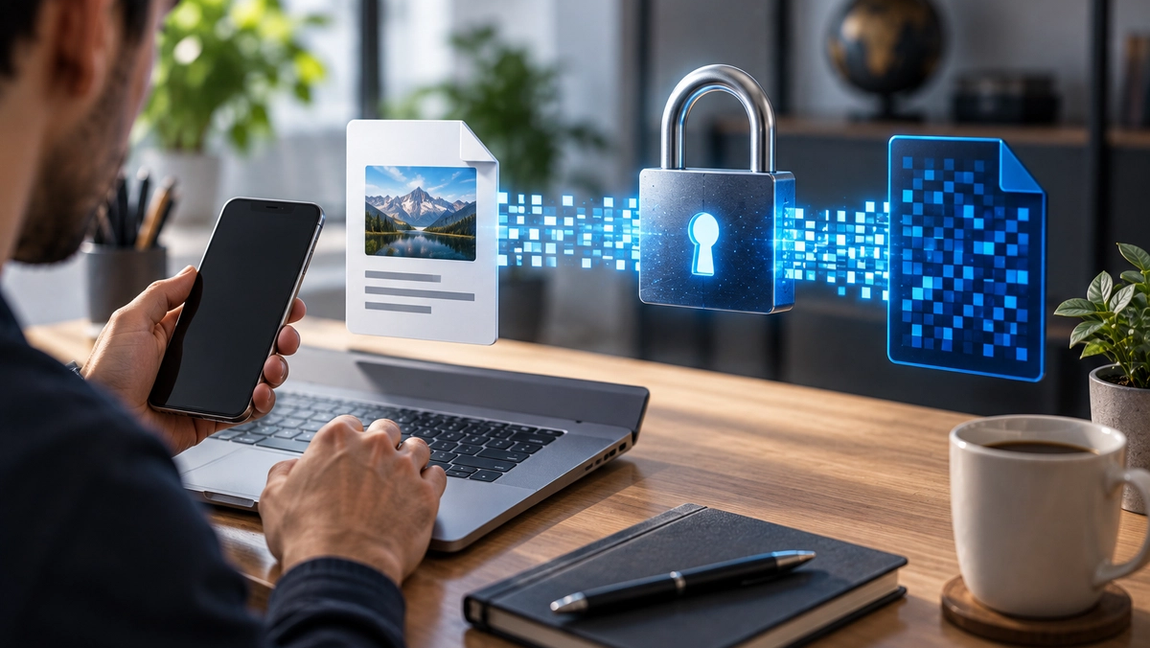
The word sounds highly technical, but the basic idea is wonderfully simple: encryption takes readable information and scrambles it so that only someone with the right key can turn it back into something meaningful.
Encryption is basically a very sophisticated secret code
Imagine you want to send someone a note that says:
“Meet me at 8.”
If you send it normally and someone intercepts it, they can immediately understand the message.
Now imagine using a secret system to transform it into something like:
“X7P4-KL9-22Q.”
Anyone intercepting that version sees meaningless information. But the intended recipient has the key needed to transform it back into the original message.
That’s essentially what encryption does.
The readable original information is often called plaintext. After encryption, it becomes ciphertext. The encryption key determines how information is transformed and, depending on the system, how it can be decrypted again.
Real encryption is obviously far more sophisticated than replacing letters with random symbols. Modern encryption uses mathematical algorithms designed to make guessing the original information practically impossible without the correct key.
Your browser uses encryption constantly
You probably use encryption hundreds of times without noticing it.
Look at the address of a modern website and you’ll usually see “HTTPS” rather than simply “HTTP.”
That extra S is important.
HTTPS creates an encrypted connection between your browser and the website’s server. When you enter information—such as a password, payment details, or a search query—the data is protected while traveling between the two.
Without encryption, someone who managed to intercept the traffic could potentially read the information directly.
With encryption, they would instead see scrambled data.
This is especially important when you’re using networks you don’t completely control, such as Wi-Fi in hotels, airports, cafés, or other public places.
Encryption doesn’t make a website trustworthy, however. A scam website can also use HTTPS. Encryption protects the connection; it doesn’t guarantee that the person or company at the other end deserves your information.
There are different ways to use encryption keys
One important distinction in encryption is how the keys work.
In symmetric encryption, the same secret key is used to encrypt and decrypt information.
Imagine you and a friend have identical keys to a locked box. You put a message inside, lock the box, and send it to your friend. Your friend uses their copy of the same key to open it.
This can be extremely fast and effective, but it creates an obvious problem: how do you safely give the other person the key in the first place?
That’s where asymmetric encryption becomes useful.
Asymmetric systems use two related keys: a public key and a private key.
The public key can be shared openly. The private key stays secret.
A simplified analogy is a mailbox. Anyone can put a letter through the slot, but only the person with the mailbox key can open it and retrieve what’s inside.
This approach helps computers establish secure communication even when they have never communicated before.
In practice, modern secure systems often combine different encryption techniques to get the advantages of both.
What end-to-end encryption actually means
You’ve probably seen messaging apps advertise “end-to-end encryption.”
The phrase has an important meaning.
With end-to-end encryption, a message is encrypted on your device and designed to be decrypted only on the recipient’s device.
Imagine Alice sends Bob the message:
“Happy birthday!”
Before leaving Alice’s phone, the message becomes encrypted. It travels through the messaging company’s servers in encrypted form and is decrypted when it reaches Bob’s device.
The service carrying the message shouldn’t need to read its contents in order to deliver it.
That’s different from a system where information is encrypted while traveling across the internet but becomes readable on the company’s servers.
Both can use encryption, but end-to-end encryption provides an additional layer of privacy by limiting who can access the readable content.
Encryption also protects stored information
Encryption isn’t only useful when information is moving across the internet.
It can protect data sitting on a device too.
Modern smartphones and computers can encrypt their storage. If someone steals an encrypted phone, they shouldn’t be able to simply remove the storage components and immediately read everything.
The information remains encrypted until the device is properly unlocked.
This is one reason having a strong passcode matters.
Your four- or six-digit code may look completely unrelated to sophisticated cryptography, but the device’s security system can use your authentication to help protect access to encryption keys.
Cloud services may also encrypt information stored on their servers, although exactly how those systems work—and who can access the decrypted data—depends on the service.
Can encrypted information be cracked?
Technically, many encryption systems could be defeated if an attacker could somehow try enough possible keys.
The important question is how long that would take.
Modern encryption can use keys with an unimaginably large number of possible combinations. Trying every possibility could require an absurd amount of computing time.
That’s what makes good encryption effective.
Attackers therefore often look for easier ways around it.
Instead of breaking the encryption itself, they might steal someone’s password through phishing, infect a device with malware, exploit a software vulnerability, or trick someone into revealing access credentials.
It’s a little like encountering an incredibly strong bank vault and deciding it would be easier to steal the manager’s key than drill through the door.
Encryption can be extremely strong while the humans and systems surrounding it remain vulnerable.
Encryption isn’t magic, but it makes modern life possible
Encryption doesn’t solve every cybersecurity problem.
It can’t prevent you from giving your password to a fake login page. It can’t guarantee that the person receiving your message won’t screenshot it. It can’t make a malicious website trustworthy. And it can’t protect information once an attacker has legitimate access to an unlocked device.
But it does something extraordinarily important.
It allows information to travel and be stored in places that aren’t inherently private while remaining extremely difficult for unauthorized people to understand.
Without encryption, online banking, private messaging, digital payments, cloud storage, remote work, and much of modern internet life would be dramatically less secure.
And underneath all the complicated mathematics is a very old idea.
Take something you want to keep private. Lock it in a form outsiders can’t understand. Give the right people a way to unlock it.
Human beings have been creating secret codes for thousands of years.
We’ve just gotten extraordinarily good at making them.